On November 17, 2026, NVIDIA reported exceptional financial results for the third quarter of fiscal year 2027. Revenue reached $115.8 billion, up 103% year over year. Net income amounted to $65.3 billion, up 105%.
But behind these spectacular results, a balance sheet analysis reveals a worrying trend. Accounts receivable are growing faster than revenue, net cash is plunging, equity investments are multiplying, and financial commitments are reaching considerable levels.
NVIDIA is no longer simply selling the equipment needed to develop artificial intelligence. The American company is gradually becoming one of the leading financial backers of its own industrial ecosystem.
NVIDIA: A balance sheet undergoing a major transformation
In nine months, NVIDIA’s total assets increased from $206.8 billion to $372.2 billion, representing an 80% increase. However, the changing structure of the balance sheet, rather than its growth alone, deserves our attention.
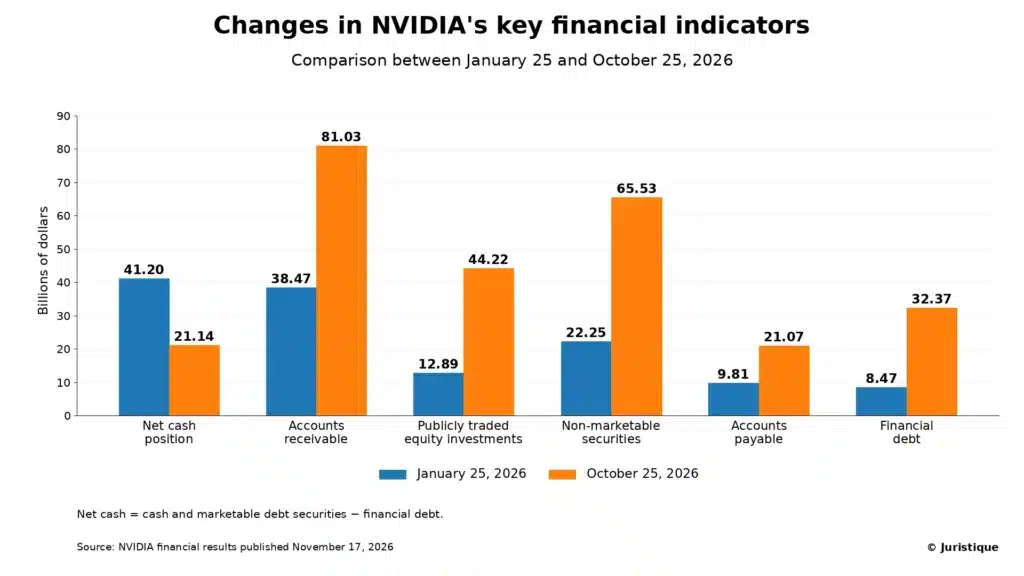
Changes in NVIDIA’s key balance sheet items in 2026
| In billions of US dollars | January 25, 2026 | October 25, 2026 | Change |
|---|---|---|---|
| Cash and cash equivalents | 10.61 | 29.09 | +174% |
| Marketable debt securities | 39.07 | 24.42 | −37% |
| Publicly traded equity investments | 12.89 | 44.22 | +243% |
| Accounts receivable | 38.47 | 81.03 | +111% |
| Inventories | 21.40 | 39.72 | +86% |
| Privately held equity investments | 22.25 | 61.65 | +177% |
| Total assets | 206.80 | 372.19 | +80% |
| Accounts payable | 9.81 | 21.07 | +115% |
| Financial debt | 8.47 | 32.37 | +282% |
| Shareholders’ equity | 157.29 | 266.67 | +70% |
Source: NVIDIA’s consolidated financial statements as of October 25, 2026. Selected balance sheet items.
With shareholders’ equity accounting for nearly 72% of total assets, NVIDIA maintains a strong financial position. However, a growing proportion of its assets now depends on the creditworthiness of its customers and the valuation of its financial investments.
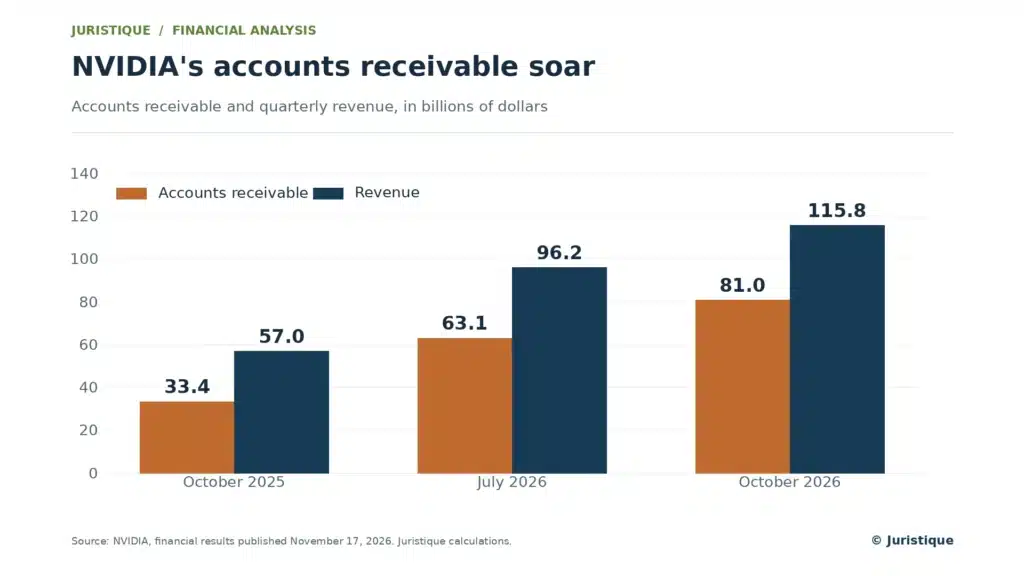
NVIDIA’s accounts receivable reach $81 billion
In October 2025, NVIDIA’s accounts receivable amounted to $33.4 billion. One year later, they reached $81 billion, an increase of 143%, compared with revenue growth of 103%. NVIDIA is therefore extending proportionately more credit to its customers.
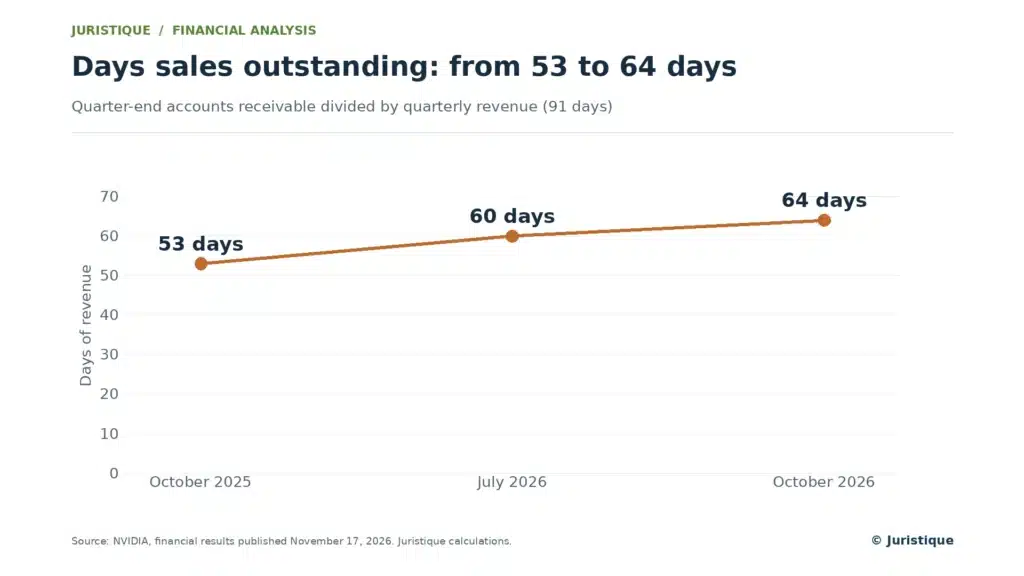
Changes in NVIDIA’s customer credit and payment periods
| Indicator | October 2025 | July 2026 | October 2026 |
|---|---|---|---|
| Quarterly revenue | $57.0bn | $96.2bn | $115.8bn |
| Accounts receivable | $33.4bn | $63.1bn | $81.0bn |
| Days sales outstanding (DSO) | 53 days | 60 days | 64 days |
NVIDIA’s financial management acknowledges that it has extended payment terms to certain creditworthy customers under multi-quarter agreements. It also attributes this trend to shipment timing related to its next-generation Rubin processors.
In its quarterly report for the period ended July 26, 2026, NVIDIA states that it has granted certain creditworthy customers payment terms ranging from 90 days to one year. These extended payment terms are intended to support the construction of large data centers.
The increase in customer payment periods from 53 to 64 days represents nearly $14 billion in additional cash tied up in receivables at the current revenue level.
Two customers account for 35% of NVIDIA’s receivables
The concentration of customer credit risk is another cause for concern. Two customers account for 18% and 17%, respectively, of NVIDIA’s accounts receivable as of October 25, 2026.
These two customers alone owe the American company approximately $28.4 billion. NVIDIA does not disclose their identities in its quarterly financial disclosures.
This concentration does not mean that these receivables are doubtful. However, it exposes NVIDIA to potential financial difficulties affecting a very small number of companies.
Does supplier credit offset the increase in accounts receivable?
NVIDIA’s accounts payable have also increased significantly, rising from $8.6 billion in October 2025 to $21.1 billion in October 2026.
Supplier payment periods, estimated using the cost of revenue, increased from approximately 52 to 66 days over the same period.
Nevertheless, the amount of credit obtained from suppliers remains substantially lower than the credit extended to customers. This is partly explained by NVIDIA’s exceptionally high gross margin, which reached 74.8% in the third quarter of 2026.
Trade working capital doubles in nine months
| In billions of US dollars | January 2026 | October 2026 |
|---|---|---|
| Accounts receivable | 38.47 | 81.03 |
| Inventories | 21.40 | 39.72 |
| Less: Accounts payable | 9.81 | 21.07 |
| Trade working capital | 50.06 | 99.68 |
Nearly $50 billion in additional capital has been tied up in NVIDIA’s operating cycle in just nine months. This increase reflects both rapid business growth and changes in the financing terms offered to customers.
NVIDIA now holds $106 billion in equity investments
The most striking development concerns NVIDIA’s equity investments in other companies.
In January 2026, NVIDIA held $35.1 billion in publicly traded and privately held equity securities. Nine months later, their carrying value reached $105.9 billion.
Changes in NVIDIA’s equity investment portfolio
| In billions of US dollars | January 2026 | October 2026 |
|---|---|---|
| Investments in publicly traded companies | 12.89 | 44.22 |
| Investments in privately held companies | 22.25 | 61.65 |
| Total equity investments | 35.14 | 105.87 |
| Percentage of total assets | 17.0% | 28.4% |
Equity investments now account for more than a quarter of NVIDIA’s total assets.
This table excludes $4.7 billion in equity investments in publicly traded companies classified as other assets due to resale restrictions.
During the first nine months of its fiscal year, NVIDIA spent $58.1 billion purchasing equity securities, compared with just $4.95 billion during the same period of the previous fiscal year.
What are NVIDIA’s largest publicly traded equity investments?
The Form 13F filing submitted to the Securities and Exchange Commission (SEC) on November 16, 2026, identifies NVIDIA’s largest reported equity holdings as of September 30, 2026.
| Company | Value of investment |
|---|---|
| SpaceX | $19.68 billion |
| Intel | $19.37 billion |
| CoreWeave | $4.11 billion |
| Coherent | $2.24 billion |
| Synopsys | $1.89 billion |
| Nokia | Approximately $700 million |
| Nebius | Approximately $300 million |
| Generate Biomedicines | Approximately $13 million |
| Total reported portfolio | $48.33 billion |
- SpaceX and Intel alone account for nearly 81% of the reported portfolio value.
- At the same time, NVIDIA invests in privately held companies, particularly in artificial intelligence and computing infrastructure financing.
- These investments increasingly expose NVIDIA’s earnings to financial market fluctuations and technology company valuations.
Is NVIDIA indirectly financing its own customers?
The business model developing around NVIDIA raises a fundamental question.
NVIDIA invests in artificial intelligence companies. These companies use the capital they raise to fund their development and purchase computing power from cloud service providers. In turn, these cloud service providers purchase NVIDIA processors and equipment.
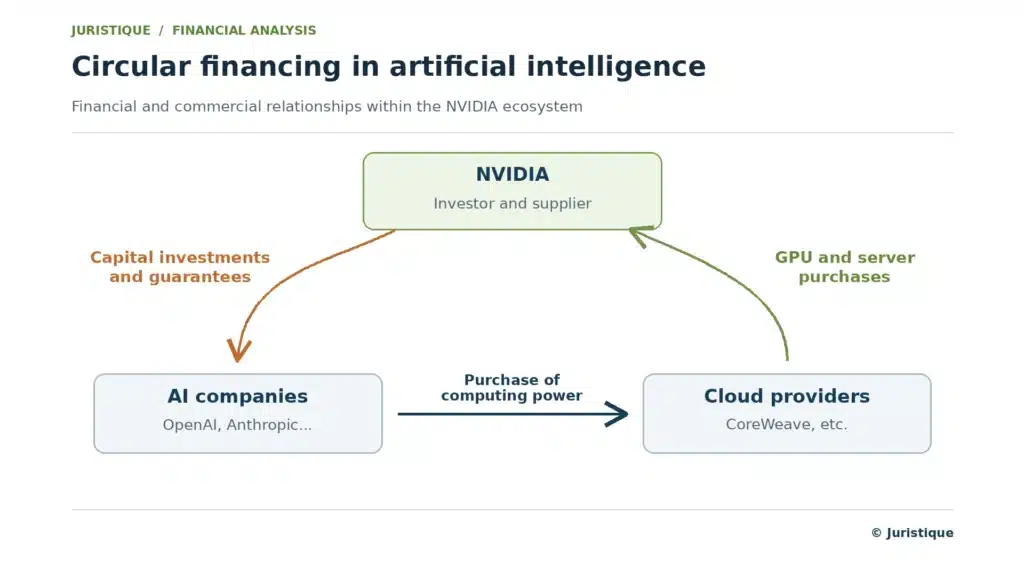
This circular financing mechanism can be summarized as follows:
- NVIDIA invests in an artificial intelligence company.
- The company purchases computing capacity from a cloud service provider.
- The cloud service provider purchases NVIDIA equipment.
- NVIDIA generates revenue and may benefit from the appreciation of its equity investments.
This mechanism makes sense from an industrial perspective. It accelerates the development of the artificial intelligence market and helps overcome some of the financial barriers to building new infrastructure.
However, part of the demand may consequently depend on financing provided by the equipment supplier itself.
What would demand for NVIDIA processors look like if the company stopped financing part of its ecosystem tomorrow? The financial information currently available does not answer this question.
$668 billion in financial and industrial commitments
NVIDIA’s balance sheet provides only a partial picture of the company’s economic commitments.
As of October 25, 2026, NVIDIA’s future commitments and financial guarantees amounted to a combined gross total of $668 billion.
Breakdown of NVIDIA’s future commitments and financial guarantees
| Nature of commitments | Amount |
|---|---|
| Future purchases and manufacturing capacity | $390bn |
| Future data center leases | $74bn |
| Cloud service agreements | $28bn |
| Future equity investments | $20bn |
| Capital expenditures | $6bn |
| Conditional commitments to specialized cloud providers | $32bn |
| Maximum exposure under financial guarantees | $118bn |
| Combined gross total | $668bn |
This amount represents approximately 180% of NVIDIA’s total assets and 250% of its shareholders’ equity.
However, it is important to distinguish between commercial commitments, future investments, and conditional guarantees. These amounts do not constitute debt that is immediately payable. They represent obligations and financial exposures of different types extending over several years.
Supply commitments alone increased from $279 billion to $390 billion in a single quarter. This increase primarily reflects multi-year agreements to purchase memory chips.
If demand slows, these commitments could limit NVIDIA’s ability to adjust its procurement levels quickly.
NVIDIA guarantees up to $105 billion for a project intended for OpenAI
In August 2026, NVIDIA agreed to provide financial guarantees for a major data center construction project in Ohio, United States.
The project, led by SB Energy, involves nine buildings representing approximately 4.25 gigawatts of total power capacity. The facilities are expected to house NVIDIA equipment and be leased to OpenAI for 20 years.
NVIDIA’s maximum financial exposure under these guarantees amounts to $105 billion.
The guarantees will gradually become effective as the buildings begin operations. The first such milestone is expected during fiscal year 2029.
NVIDIA states that it had made no payments under these guarantees as of the date of its earnings release.
Nevertheless, this transaction illustrates the transformation of the American chipmaker’s business model. NVIDIA is becoming not only the equipment supplier but also a financial guarantor of the infrastructure required to operate that equipment.
A decline in earnings-to-cash conversion
Despite exceptional earnings growth, a smaller share of net income is converting into operating cash flow.
Comparison of NVIDIA’s earnings and cash flows
| First nine months of the fiscal year, in billions of US dollars | 2025 | 2026 |
|---|---|---|
| Revenue | 147.81 | 293.68 |
| Net income | 77.11 | 183.30 |
| Operating cash flow | 66.53 | 122.68 |
| Operating cash flow as a percentage of net income | 86.3% | 66.9% |
| Net gains on equity securities | 3.43 | 25.47 |
| Purchases of equity securities | 4.95 | 58.10 |
Two factors help explain this trend: rising working capital requirements and the recognition of financial gains on equity investments.
During the first nine months of its fiscal year, NVIDIA recorded $25.5 billion in net gains on equity securities.
Conversely, during the latest quarter, the company also recorded approximately $1.8 billion in impairment losses on its privately held equity investments.
Fluctuations in the value of NVIDIA’s investment portfolio are thus becoming a significant component of its financial results.
NVIDIA’s net cash position has nearly halved
Although NVIDIA generated more than $183 billion in net income over nine months, its net cash position, excluding equity securities, declined.
| In billions of US dollars | January 2026 | October 2026 |
|---|---|---|
| Cash and marketable debt securities | 49.67 | 53.51 |
| Financial debt | 8.47 | 32.37 |
| Net cash position | 41.20 | 21.14 |
NVIDIA’s net cash position declined by nearly 49% in nine months. Over the same period, financial debt almost quadrupled.
This trend is partly explained by financial investments, increased working capital requirements, dividends, and share repurchases.
NVIDIA spent more than $73 billion on dividends and share repurchases during the first nine months of its fiscal year.
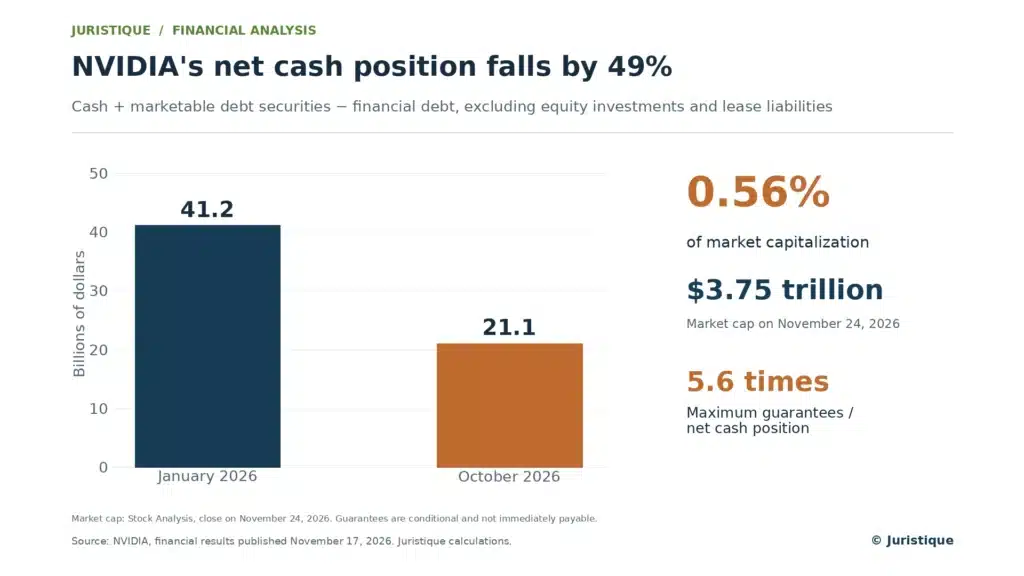
Another cause for concern is that NVIDIA’s financial guarantees, with a maximum exposure of $118 billion, represent 5.6 times its net cash position as of October 25, 2026. However, these guarantees remain conditional and may be called over several years.
What risks would NVIDIA face in the event of an AI market downturn?
The main concern is the strong correlation among the risks to which NVIDIA is now exposed.
A sharp slowdown in artificial intelligence investment could have several simultaneous consequences:
- A decline in processor and computing equipment sales.
- Difficulties collecting outstanding accounts receivable.
- A decline in the value of equity investments in technology companies.
- Calls on financial guarantees in the event of default by certain business partners.
- Component purchase commitments exceeding actual demand.
- An increase in inventories and financing requirements.
For illustrative purposes, a 5% loss on accounts receivable, a 40% decline in the value of equity investments, and a loss equivalent to 10% of maximum financial guarantee exposure would result in a combined theoretical loss of $58.2 billion, representing nearly 22% of NVIDIA’s current shareholders’ equity.
This scenario is not a forecast. It does not account for taxation, future earnings, potential recoveries, or when the financial guarantees become effective.
Nevertheless, it illustrates the scale of the financial risks the company has accumulated.
NVIDIA: From chipmaker to financier of artificial intelligence
NVIDIA’s industrial performance remains exceptional. The company benefits from high profitability, substantial shareholders’ equity, and a considerable ability to generate cash.
It would therefore be premature to conclude that NVIDIA faces immediate financial difficulties.
However, NVIDIA is gradually changing its nature. The company sells equipment, invests in the businesses that use it, extends customer payment terms, and guarantees part of the financing of the infrastructure required to operate its products.
The success of its customers is therefore becoming not only a condition for revenue growth but also a key factor in valuing its financial assets and managing its future commitments.
In the event of an AI market downturn, NVIDIA could be affected simultaneously as a manufacturer, creditor, shareholder, and financial guarantor.
This is arguably NVIDIA’s most significant financial risk today.
Sources and methodology
This analysis is based on the financial documents NVIDIA published on November 17, 2026; its unaudited interim financial statements as of October 25, 2026; and its regulatory disclosure of publicly traded equity holdings.
- NVIDIA Announces Financial Results for Third Quarter Fiscal 2027
- NVIDIA’s supplemental financial information filed with the SEC
- NVIDIA’s CFO commentary on financial results and commitments
- NVIDIA’s Form 13F filing dated November 16, 2026
What do you think of NVIDIA’s financial strategy? Are you confident in its continued growth?
….. Let us know in the comments!
