Alphabet, Google’s parent company, released its third-quarter 2026 financial results on October 28, 2026 (covering July through September). Despite revenue of $127.6 billion, up 25% year over year, the company fell short of Wall Street’s expectations. The reasons include slowing growth in advertising revenue, the cornerstone of its business model, and rising spending on artificial intelligence.
- Alphabet reported mixed results for the third quarter of 2026: revenue rose 24.7%, while net income fell 25.2%.
- Artificial intelligence is reshaping Google’s business model. AI-generated answers displayed directly in search results reduce visits to the websites that produce the information.
- In our view, Google News shows an ideological imbalance. Of 33 links recorded on October 29, 2026, 63.6% came from outlets we classify as left-wing or far-left, compared with 12.1% from right-wing outlets.
- Channel removals and demonetization on YouTube illustrate Google’s considerable power over distribution information and creators’ income.
- By filtering content and favoring certain media outlets, Google risks undermining its users’ trust. This is a strategic risk the company appears to underestimate.
One widely cited explanation is that artificial intelligence threatens Google’s business model: users can now get answers without necessarily visiting the websites that produce the information. By diverting web traffic in this way, Google could ultimately become a victim of its own strategy.
But what if the explanation lies elsewhere—in the gradual deterioration of the quality of information Google promotes? By filtering content, engaging in shadow banning, favoring certain media outlets, and marginalizing others, the American tech giant is helping to impoverish the information available to its users.
Contents
Disappointing Quarterly Results
The decline in net income was primarily driven by a reversal in investment gains and losses: a $10.7 billion gain in the third quarter of 2025 versus an $8.7 billion loss in the third quarter of 2026.
Figures in billions of U.S. dollars.
| Alphabet Financial Results, Third Quarter 2026 | Q3 2025 | Q3 2026 | Change |
|---|---|---|---|
| Revenue | 102.35 | 127.58 | +24.7% |
| Advertising revenue | 74.18 | 82.01 | +10.6% |
| Google Search advertising | 56.57 | 63.35 | +12.0% |
| YouTube advertising | 10.26 | 11.21 | +9.2% |
| Google Cloud | 15.16 | 30.71 | +102.6% |
| Net income attributable to common stockholders | 34.98 | 26.17 | −25.2% |
Source: Alphabet’s official financial results, released October 28, 2026.
The main warning sign is advertising: revenue growth of 11% fell short of the 13% analysts had expected.
Despite the cloud revenue surge, investors punished the results: Alphabet shares fell more than 10% in after-hours trading on Wall Street.
The Growing Importance of AI
Artificial intelligence is disrupting Google’s business model. Google Cloud is benefiting enormously, with revenue up a spectacular 103% year over year. But AI-generated answers reduce visits to websites, particularly those supported by advertising, while AI Mode’s still-limited monetization is holding back growth in Google’s advertising revenue.
A Pew Research Center study published in July 2025 confirms this trend: only 8% of searches showing an AI summary led to a click on a traditional search result, compared with 15% of searches without one.
Google and the Enshittification of the Web
Writer Cory Doctorow notably described enshittification. It refers to the gradual deterioration of digital services as they increasingly put their commercial interests ahead of their users.
In my view, Google bears much of the responsibility for this trend. By imposing its search-ranking criteria, the company encourages content tailored to its algorithms rather than to readers. The consequences include ubiquitous advertising, articles with little added value, repetitive content, and increasingly uniform information.
Google is therefore helping degrade the quality of the web that generates most of its revenue.
Google News: A Façade of Media Pluralism?
The Same Media Outlets, Again and Again
Google News gives considerable prominence to major traditional media outlets. Ouest-France, Le Figaro, and leading French national newspapers appear repeatedly with similar stories, often covered from the same angle.
This concentration is all the more regrettable because the French press already receives substantial public funding: €144.7 million in direct subsidies in 2025, according to the French Ministry of Culture. Small independent publications remain largely invisible in Google News feeds. One notable exception is Korben, a technology publication.
An Ideologically Skewed Selection
In my view, this concentration reflects an ideological imbalance. Openly partisan outlets such as Mediapart and Reporterre regularly appear in the selections I see, while others, such as Frontières, are far less visible.
The issue isn’t to challenge Mediapart’s or Reporterre’s right to defend their convictions. Why doesn’t Google give media outlets representing opposing viewpoints comparable visibility?
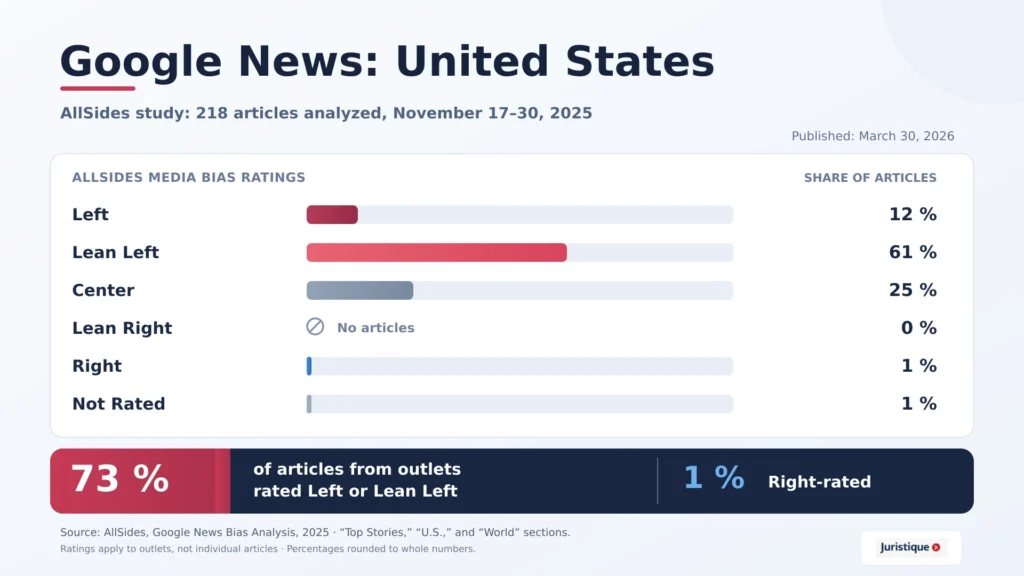
The same phenomenon appears to exist in the United States. A 2026 study by AllSides found that, among 218 articles analyzed on Google News in November 2025, 73% came from outlets classified as left-leaning, compared with just 1% from right-leaning outlets.
Right-wing voters nevertheless make up a significant share of the electorate. With just 1% of the articles coming from outlets classified as right-leaning, Google News projects an image of ideologically biased pluralism. Is it any wonder that many users might lose trust and look for alternatives outside Google’s ecosystem?
By contrast, X offers, in my view, a freer space for expression, where conflicting political opinions can confront one another. This approach could eventually make Google look outdated if the company continues to prioritize its ideological choices over its own economic interests and those of its shareholders.
Zombie News Sites
Another surprising phenomenon is the recurring presence of low-value news websites with obscure or interchangeable names.
Recycled articles, clickbait headlines, a lack of original reporting, and content produced solely to attract visitors: some of these sites look more like click farms than genuine news outlets. Why does Google give them visibility while original, specialized publications struggle to break through?
YouTube: Censorship Is Everywhere
On YouTube, censorship reigns supreme. Video removals, channel shutdowns, and demonetization affect creators and media outlets across a wide range of political viewpoints.
There is no shortage of examples:
- YouTube removed Xavier Moreau’s Stratpol channel in October 2022. It now distributes its programs on platforms including Odysee and Rumble.
- France-Soir, whose channel was removed in March 2021, announced its return to YouTube in October 2025, after more than four years away.
- Psyhodelik, a French video creator, saw both of his YouTube channels demonetized in September 2026. After his appeal was rejected, he decided to remove nearly all of his older videos himself, fearing further sanctions. Deprived of advertising income, he launched a fundraising appeal on Patreon and Tipeee.
- Blast, an independent left-wing media outlet, denounced the blocking of a YouTube program on October 1, 2026, about the media’s coverage of Rima Hassan. France Télévisions eventually restored the video after intervening, saying the block was a mistake.
Although the reasons and circumstances differ, these cases illustrate YouTube’s considerable power over information distribution and creators’ income.
In response, many creators are trying to reduce their dependence on Google and are turning to alternatives such as Rumble, Odysee, PeerTube, or X, Elon Musk’s social network.
Conclusion
Much like Apple with its smartphones, Google built its success on the quality of its services. But by continually seeking to satisfy governments and control information, the American tech giant risks eroding user trust.
Google must now choose: preserve that trust or continue pursuing a policy that I see as increasingly subservient to political demands, at the risk of suffering Nokia’s fate in the smartphone market. The market’s negative reaction to its financial results is a warning.
We Want to Hear from You
Let us know what you think in the comments. THANK YOU.
