The European Union is faltering in the international race for leadership in the development and use of artificial intelligence (AI), according to a new report released today by the Center for Data Innovation. The report finds that the United States holds an early lead in AI capability, but China is mounting a strong challenge on several important fronts, while the EU is falling behind both.
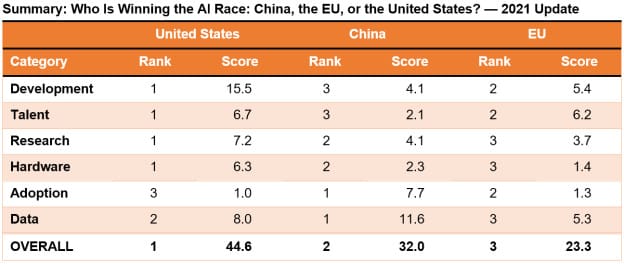
The report assesses the AI capabilities of the EU, the United States, and China using 30 metrics across 6 categories representing the essential building blocks for national success in AI: talent, research, commercial development activity, hardware infrastructure, adoption, and data availability.
On a 100-point scale, the European Union comes last, scoring 23.3 points. The United States leads, with 44.6 points, followed by China with 32.0. These results are similar to findings the Center first reported in 2019, but with notable shifts in key areas—including the quantity and quality of AI research being conducted, software and computer services firms’ expenditures on research and development, the number of advanced supercomputers, and the quantity of data being generated—suggesting that the Chinese government’s concerted policies to make AI a top strategic priority are bearing fruit, and that the EU and United States should respond.

“The biggest challenge for the EU and member states is that many in Europe do not trust AI. They see it as technology to be feared and constrained, rather than welcomed and promoted,” says Daniel Castro, director of the Center for Data Innovation and lead author of the report. “Meanwhile, the Chinese government has made AI a top priority and the results are showing. China is getting closer to the United States and increasingly outpacing the European Union.”
The report finds that since 2019, China has surpassed the EU as the global leader in AI research publications, while also increasing its research quality. In contrast, the EU has made progress relative to the United States in only slightly more than a quarter of the updated metrics, and it has fallen farther behind in the number of AI-related venture funding deals, AI firm acquisitions, and AI start-ups that have raised at least $1 million. The report also shows that China has closed the gap or extended its lead over the United States in more than half of the updated metrics. For example, China now has nearly twice as many supercomputers ranked in the top 500 for performance as the United States.
The Center offers a series of policy recommendations for policymakers to respond to China’s AI challenge. For Europe, the report calls for better and more consistent R&D tax incentives, expanded public research institutes, and more high-performance computing centers. But above all, the Center argues the EU and its member states must welcome and promote AI rather than constrain it through its existing and proposed regulatory policies.
“Without significant policy changes, it’s likely China will eventually close the gap with the United States, and the EU will remain well behind,” said Castro. “Instead of taking only piecemeal steps, the EU needs to fundamentally rethink its regulatory approach to AI to make it much more innovation-friendly and embrace policies to spur commercial adoption of AI, especially by mid- and large-sized firms. It’s continued focus on constraining AI will come at the cost of economic competitiveness and productivity.”
