Estonia was considered a destination of excellence for digital nomads. Indeed, Estonia is not a territory but a destination to host Internet companies and other startups. Tallinn‘s capital has seen the birth of digital giants such as Wise or Skype. Its success lies in creating a specific “e-residency” status that guarantees simplified procedures and advantageous taxation. Estonia will implement a new tax on profits in 2026, increasing corporate taxation and directly threatening the advantages provided by the e-resident status.
Contents
Corporate taxation in Estonia
Today, Estonia has no tax on profits, only a tax on distributed profits. Profits reinvested in the company are not subject to tax, which is a considerable advantage over other countries such as France. So you can generate cash in the company, keep it, and wait for the right opportunity to take it out.
Moreover, the accounting rules are very flexible for digital nomads, who can quickly charge their accommodation and travel expenses abroad to the company’s accounts.
However, social security contributions (33%) and VAT (22%) are comparable to other European countries.

Significant tax changes in Estonia for 2025 and 2026
Starting in 2025, Estonia is planning several considerable tax changes:
- Dividend tax: the rate will rise from 20% to 22%.
- Abolition of the reduced rate: the reduced corporate tax rate of 14% will be abolished.
- The VAT rate will increase to 24% on 1 July 2025.
For 2026:
- New defense tax: a temporary 2% tax on corporate profits will be introduced from January 1ᵉʳ, 2026, and will remain in force until December 31, 2028.
These measures boost state tax revenues and support national defense-related spending. This profit tax will generate additional accounting costs and thus increase the cost of an economic structure in Estonia.
Estonia is going through a difficult time.
Growing economic difficulties in Estonia and raising taxes
Estonia is going through a difficult economic period, marked by a contraction of its gross domestic product (GDP) of 0.7% in the third quarter of 2024 compared to last year. This recession is mainly due to weak domestic demand and a decline in investments, which fell by 15.2% in the third quarter of 2024. The forecast for 2025 indicates a modest growth of 1.1%, supported by a gradual recovery in exports and an improvement in external demand.
Decline and aging of the Estonian population
Thus, on January 1, 2014, Estonia’s population was 1,315,819, compared to 1,372,071 in 2000. This was due to the departure of part of the population, as in the other Baltic countries, but especially a low fertility rate (1.37 children per woman in 2000 compared to 1.64 in 2010).
Source Wikipedia: Demographics of Estonia.
Segregation of the Russian minority
In Estonia, the Russian-speaking minority, representing approximately a quarter of the population, faces discrimination, particularly in terms of citizenship, access to employment, and education. Since independence in 1991, mastery of Estonian has become a firm requirement, limiting the integration of Russian speakers, many of whom have remained stateless. This situation has worsened with the war in Ukraine, reinforcing tensions between communities and the authorities’ distrust of this population perceived as potentially pro-Russian.
Source Amnesty International: Linguistic minorities in Estonia – Discrimination must end.
Warlike Estonian leaders
Added to the economic problems are the country’s leaders who only want to increase international tensions instead of looking after the country’s interests. The champion of the “warmongers”, Kaja Kallas, only talks about making war with Russia.
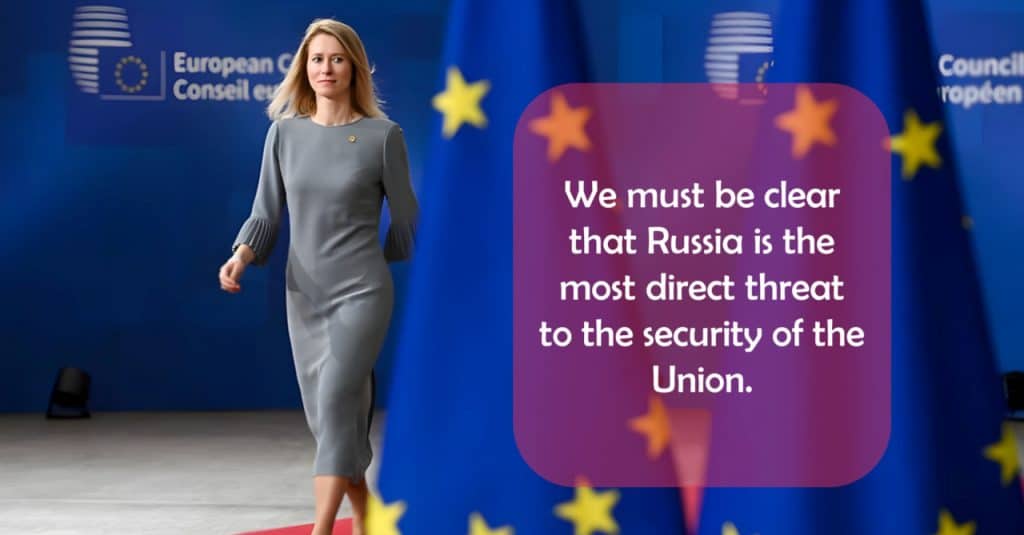
The prosperity of a country is hardly compatible with a permanent war discourse. A change of leadership in favor of pro-business leaders seems essential today to revive growth in Estonia
Estonia’s 2023 Public Accounts Fairness Problem
“Eurostat has reservations about the quality of data reported by Estonia for 2023. Eurostat is discussing with the Estonian statistical authorities the appropriate timing of recording military expenditures, which impact the deficit of about 0.4% of GDP. Estonia currently reports expenditures for subsequent reference years.“
Source: Eurostat.
And the country’s leader in 2023 was Kaja Kallas, what a coincidence! #corruption
Video: Estonia is over
Frequently Asked Questions (FAQ) about Estonia and the corporate tax system.
We’d like to hear your views on Estonia’s new corporate tax policy:
By introducing a tax on corporate profits, isn’t Estonia killing the “goose that lays the golden egg,” the Estonian e-resident status that enabled its growth? Today, I see many entrepreneurs leaving Estonia because of increasing taxation and the impossibility of lasting peace with their big neighbor, Russia.
Tell us in the comments. THANK YOU.
