Traveling today often means carrying multiple electronic devices — a laptop, smartphone, camera, e-reader, headphones, or smartwatch — and being able to recharge them easily, whether traveling alone or with family. During a several-month stay in Costa Rica, where Type A and B outlets follow the U.S. standard, I tested different solutions before settling on a simple and effective combination: a Doxuanai travel power strip paired with a 67W Ugreen portable power bank. In this article and this video, I explain why I chose this setup and which solutions I would avoid.
Contents
Video: The Travel Adapters I Use When Traveling
Solutions to Avoid
Standard Universal Travel Adapters: Not Ideal in Real-World Use
They’re often the first option travelers consider.
In practice, they have several drawbacks:
- They often stick out from the wall outlet and can feel loose or unstable.
- They usually let you plug in only one device at a time.
- They quickly become inadequate if you travel with multiple devices.
As a backup, they can help. As a primary solution, especially with lots of electronics, they’re often disappointing.
Basic USB Plug Adapters: Too Limited
Another common option is a simple plug adapter with one or two USB ports.
The problem is twofold:
- Power output may be too low for some devices.
- Charging capacity is limited when you have several devices.
That is especially true now that many devices rely on USB-C.
A Better Solution: A Travel Power Strip
Why a Travel Power Strip Makes Sense
The most practical solution I found is a travel power strip with:
- 3 AC outlets
- 2 USB-A ports
- 2 USB-C ports
- On/off switch
- Built-in protection features, according to the manufacturer
- Interchangeable plug adapters for different countries
The idea is simple: one wall outlet can power almost your entire setup.
The Travel Power Strip I Use
For my travels, I chose a Doxuanai travel power strip, designed for people carrying multiple electronic devices.
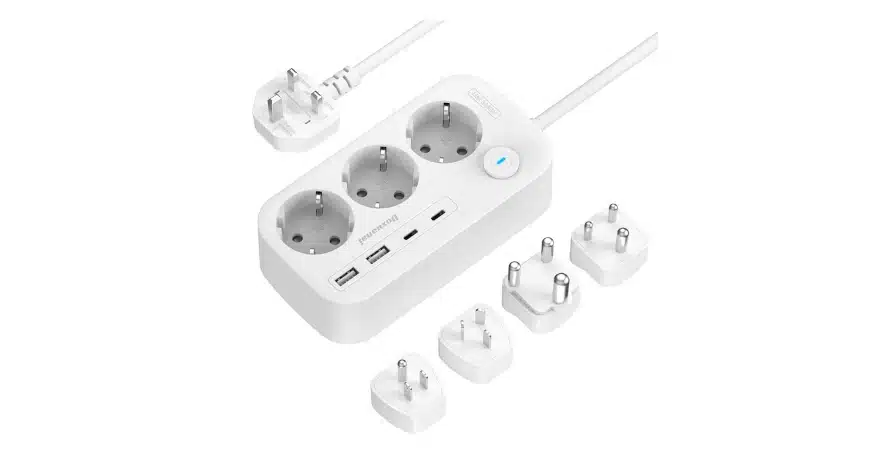
It’s more than a plug adapter — it’s a compact charging station for all your gear.
Key Features of This Model
The model I use includes the following features:
- 3 AC outlets for a laptop, chargers, or accessories
- 4 USB ports, including 2 USB-C and 2 USB-A ports
- 5-foot power cord (1.5 meters), especially useful when wall outlets are poorly located
- Europe-to-U.S. plug adapter (Type A/B), suitable for Costa Rica, the United States, and Mexico
- Compatibility is also advertised for other destinations, including Australia, Thailand, Hong Kong, and Namibia
- Built-in on/off switch
- Housing described by the manufacturer as flame-retardant up to 650°C
Why I Chose a Travel Power Strip
One Outlet to Charge Everything
With a laptop, cameras, phone, e-reader, and several batteries, I wanted to avoid carrying multiple chargers.
This power strip centralizes everything.
USB-C Makes a Real Difference
The two USB-C ports provide faster, more modern charging for many recent devices.
The 5-Foot Cable Is a Real Advantage
It may sound minor, but in hotels or rentals where outlets are hard to reach, it’s extremely useful.
More Stable Than a Standard Universal Adapter
Unlike small travel adapters that stick out and can wobble, this setup feels much more practical and secure.
The Ugreen 67W Power Bank: An Essential Companion
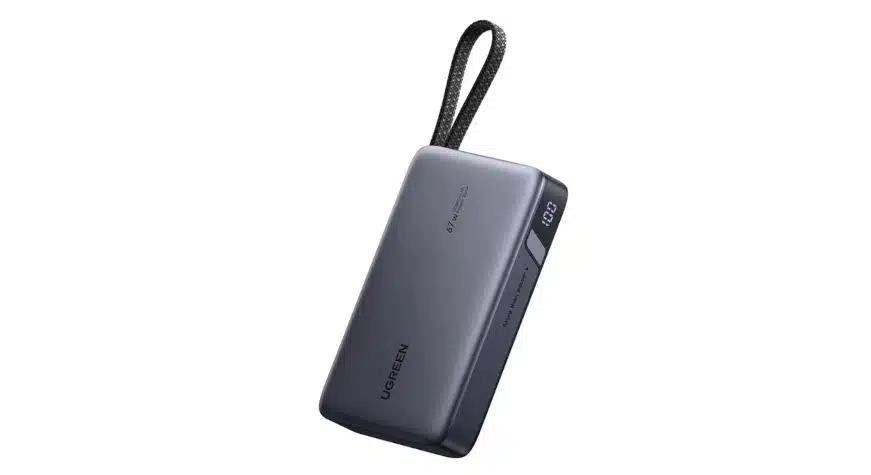
For bus travel or long days away from your accommodation, a high-capacity portable power bank can become essential.
The 67W Ugreen power bank I use offers, in particular:
- Fast charging via USB-C
- Power for a smartphone while on the move
- Backup charging for other compatible devices
FAQ on Travel Adapters, Power Banks, and Travel Power Strips
We’d love to hear your thoughts and tips for charging your devices while traveling.
Let us know in the comments. THANK YOU.
