Most French citizens retire without knowing how well they’ve got it. For example. You spent decades contributing. You worked the years, paid the contributions, navigated the reforms. And now that you are in retirement, or approaching it, a question deserves a clear answer: compared to retirees in other countries, how well are you doing?
The answer is better than you might think. Far better than most. And understanding that answer has real, practical consequences for how you might choose to live the years ahead.
Contents
How France’s Pension System Ranks Globally
The standard international measure for comparing pension systems is the replacement rate, the percentage of your pre-retirement income that your pension replaces each month. The higher the rate, the less your standard of living drops when you stop working.
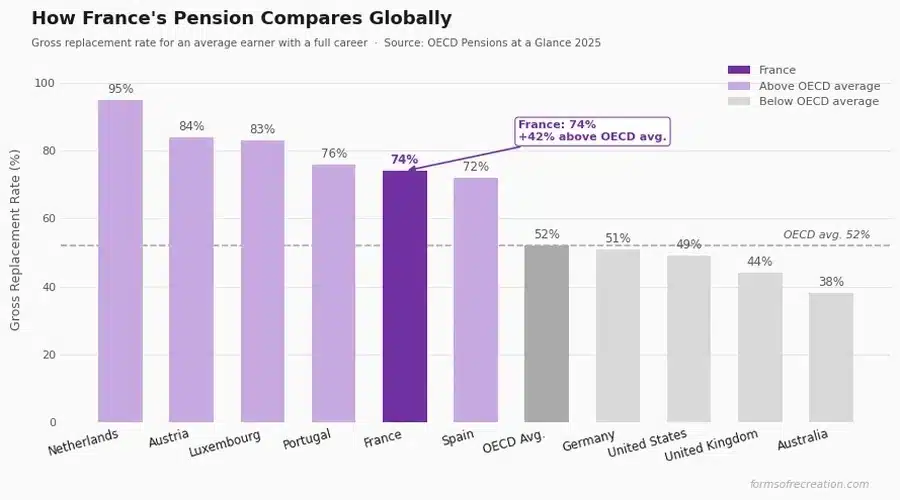
According to the OECD’s Pensions at a Glance 2025 report, the average gross replacement rate across OECD member countries is approximately 52% for an average earner with a full career. That means in a typical developed country, a retiree can expect their pension to cover just over half of what they previously earned.
France sits in a significantly more favorable position. Thanks to the combined architecture of the public regime (CNAV/CARSAT) and the mandatory occupational scheme (AGIRC-ARRCO), France belongs to the group of countries with gross replacement rates at or above 70% alongside Austria, Luxembourg, Portugal, Spain, and a handful of others. On the net replacement rate, which accounts for the lower taxes and social charges retirees pay, the picture is even more reassuring: France’s net rate is meaningfully above the OECD average of 63.2%.
In practical terms, this means that a French retiree who earned an average salary during their career does not face the dramatic income cliff that their counterparts in countries like the United Kingdom, the United States, or Australia typically experience. Retirement in France is designed, structurally, to be a continuation of a reasonable standard of living, not a sudden, uncomfortable descent.
The 2026 revalorization of general regime pensions, now confirmed, reinforces this protection further. The increase preserves purchasing power against inflation, and signals that the system, despite ongoing debates about its long-term sustainability, continues to prioritize the income security of current retirees.
France also allows a relatively early exit from working life. With the required contribution years, many workers can access their full pension from age 62.5. This means that in France, retirement is not just financially adequate; it often arrives while people are still in good health, with high energy, and with decades of active life ahead.
A Generation With Real Financial Freedom
The financial picture of the average French retiree is stronger than most suspect, including by retirees themselves.
In 2024, France had 19 million people over the age of 60, representing 28% of the national population. This is the only age group in France that is still growing. Projections indicate that the over-80 population will increase by a further 30% by 2030.
Crucially, French seniors enjoy a median standard of living approximately 12% higher than that of people aged 50 to 64, the group still in the final stretch of their working lives. Around 70% of seniors own their homes outright, typically having cleared their mortgages before or during retirement. Pension income, unlike employment income, is stable and predictable. It does not depend on the health of the economy, the decisions of an employer, or the fluctuations of the job market.
This combination- reliable income, manageable housing costs, good health in early retirement- creates something that is genuinely rare: freedom to choose how to spend your time and your money, not just manage it.
What Are French Retirees Choosing to Do With That Freedom
The honest answer is that retirees are challenging the expectations of almost everyone who once predicted a generation that would quietly fade into watching the news from a couch and frequently attending medical appointments.
The most dynamic areas of spending growth among French seniors are leisure, sports, travel, and cultural activities. French household data shows over €16 billion spent each year on gardening and pet care, over €15 billion on games, sporting goods, and toys, and over €14 billion on books, press, and stationery. These are not passive or emergency purchases. These are investments in living actively: in doing things, learning things, and staying engaged with the world.
Travel ranks among the top leisure priorities of French consumers, with France’s average domestic and outbound leisure trip lasting over 10 days. Cooking and baking, crafts, sports, walking, cultural visits, and time in nature consistently appear at the top of surveys on how French people prefer to spend their free time.
Of all these activities, hiking deserves particular attention. According to data from the Odoxa survey published via Statista in 2019, hiking is the single most practiced sporting activity among French people aged 65 and over, ahead of swimming, cycling, and every other physical pursuit. More than half of French seniors over 65 hike regularly. The Fédération Française de Randonnée (FFRandonnée) reports that the 65–69 age group is its single largest membership cohort, and French hiking and outdoor federations collectively issue more senior sports licenses than almost any other sporting organization in the country.
What is striking is how hiking evolves with the person who practices it. The retiree who sets off on a Sunday walk through the local forest is not necessarily the same person three years later. She has joined a club, bought proper boots, started planning a section of the GR10 (a 900+ kilometer long-distance trail) through the Pyrenees, and built a small community of friends who share her pace and her curiosity. She has also discovered the Camino de Santiago and is spending weeks each year walking through Spain and Portugal, staying in village guesthouses. What began as a simple, free activity has grown into a way of life, complete with gear, guided tours, annual journeys, and a social identity built around movement and discovery. Hiking does not stay modest for long when you finally have the time to do it properly.
The defining feature of this generation’s retirement is not withdrawal from society. It is reinvention in society. Recent retirees, according to research on the European silver economy, are actively seeking new experiences, new skills, and new sources of meaning, not simply maintaining the life they had before, but consciously building the life they always intended to have.
Retirement As A New Chapter of Identity
Retirement frequently marks the end of a professional identity. Leisure activities can then become a new foundation for personal identity: being a hiker, cyclist, photographer, gardener, reader, cook, traveler, or art enthusiast.

Yet, something has shifted significantly in how older adults in France relate to their leisure time, and it is worth naming clearly.
For earlier generations, hobbies were understood as ways to pass the time: pleasant, but secondary. For today’s retirees, the activities they pursue in retirement have become a central part of who they are. The person who takes up painting at 65 is not filling hours. She is building a new skill, finding a community, and defining a new version of herself. The retiree who joins a swim club at 68 is not just exercising. He is part of a culture, developing expertise, and forming friendships built around a shared passion.
Some of the world’s most compelling examples of this shift are already playing out — in the kind of experiences that French retirees are increasingly drawn to and that signal where this chapter of life is heading.
The retired man who walks into one of the Rapha Clubhouses found globally (as featured on Forms of Recreation), and joins the Rapha Cycling Club, is not simply finding a group to ride with. He is stepping into a global community of cyclists who share routes, meet at Rapha’s clubhouses, and join guided journeys to some of Europe’s most celebrated roads. The bike was the entry point. The club became part of the lifestyle.
The driving enthusiast who books the Porsche Travel Experience (as featured on Forms of Recreation) is not paying for a holiday. He is doing something he has wanted to do for decades — driving extraordinary cars on extraordinary roads, surrounded by people who feel the same way. For him, retirement was the moment he finally had the time to say yes.
The retired woman who discovers Montblanc Haus — Montblanc’s brand home in Hamburg devoted entirely to the craft of handwriting (as featured on Forms of Recreation) — is not visiting a shop. She is entering a world: a place where the lost art of writing by hand is treated as something worth preserving, practicing, and sharing with others. She leaves not just with a pen, but with a new relationship to slowing down.
These are not afterthoughts. They are the result of brands understanding something important: that for today’s retirees, identity and passion are inseparable, and the experiences that honor that connection are the ones that earn lasting loyalty.
This matters practically because it changes how retirees engage with the world around them, including which places, activities, and clubs they seek out and remain loyal to over time.
Life expectancy at 60 in France is approximately 23 additional years for men and 28 for women. That means the generation entering retirement today is approaching it with more intention and ambition than any previous generation.
A New Kind Of Experience Is Emerging Around Retirees’ Passions
Partly in response to this shift, a new model has been developing quietly across Europe and beyond, one that is particularly well suited to France’s retiree population and the country’s deep cultural emphasis on the art of living well.
Brands are recognizing that what retirees are genuinely looking for is not simply a transaction, but a place to belong, a community, a regular rhythm, a context in which to develop and share something they care about. The result is a growing ecosystem of hobby-driven experiences designed specifically for this chapter of life.
For a long time, brands mainly tried to retain customers through points, discounts, or commercial perks. But they often create a fragile relationship: customers come back only as long as the promotion remains attractive.
Recreation works differently. When a brand manages to offer a club, a place, or an activity around a genuine passion, it no longer sells only a product. It offers a world that customers can become attached to.
For French retirees with the financial stability that a strong pension provides, and with the decades of active life that an early retirement age makes possible, the question is increasingly not Can I afford this? But Which of these experiences is worth my time?
Box: What Is Forms of Recreation?
Forms of Recreation is a platform built around a simple idea: Recreation can offer adults a sense of continuity, connection, participation, and belonging, especially when supported by brands that share their form of recreation. We help adults discover travel destinations that feature experiences from these brands.
Additionally, Forms of Recreation helps marketing teams learn how other companies inside and outside their industry extend into hobby-driven experiences as a brand advantage.
The platform features :
- Travel destinations offering experiences by brands that share your form of recreation,
- Hobby-driven experiences such as clubs to join, places to visit, and activities to engage in,
- Podcasts for marketing teams
Summary
For French seniors approaching retirement or have recently retired, here are four practical ways to think about this chapter:
- Understand your replacement rate. Knowing your actual replacement rate removes uncertainty and allows you to plan concretely.
- Budget for experience, not just essentials. Many retirees over-budget for emergencies and under-budget for the activities that will give their retirement meaning. With France’s pension architecture providing a solid base, there is often more room for discretionary spending on hobbies and leisure than retirees initially assume.
- Seek out communities, not just activities. The research on wellbeing in retirement consistently points to social connection as one of the strongest predictors of health and happiness. An activity pursued in a community, such as a club, offers something that solitary hobbies, however enjoyable, cannot fully replicate.
- Think in decades, not years. A French retiree who stops working at 63 may have 25 or more years ahead. The choices made in the first few years of retirement about how to spend time and build social networks have had compounding effects over that period. This is worth taking seriously from the beginning.
For French seniors, this shift opens up new opportunities: more clubs to join, more activities to engage in, more places to meet, and more experiences adapted to their desires.
For brands, the message is clear: a loyal customer is not only a customer who buys again. It is a customer who feels they belong.
Sources: OECD, Pensions at a Glance 2025; Forms of Recreation, “For Brands” resources; Silver Marketing Association, data on the senior market in France.
Frequently Asked Questions (FAQ) About Forms of Recreation
We Are Interested in Your Opinion on the Forms of Recreation Approach:
Tell us in the comments. THANK YOU.
